
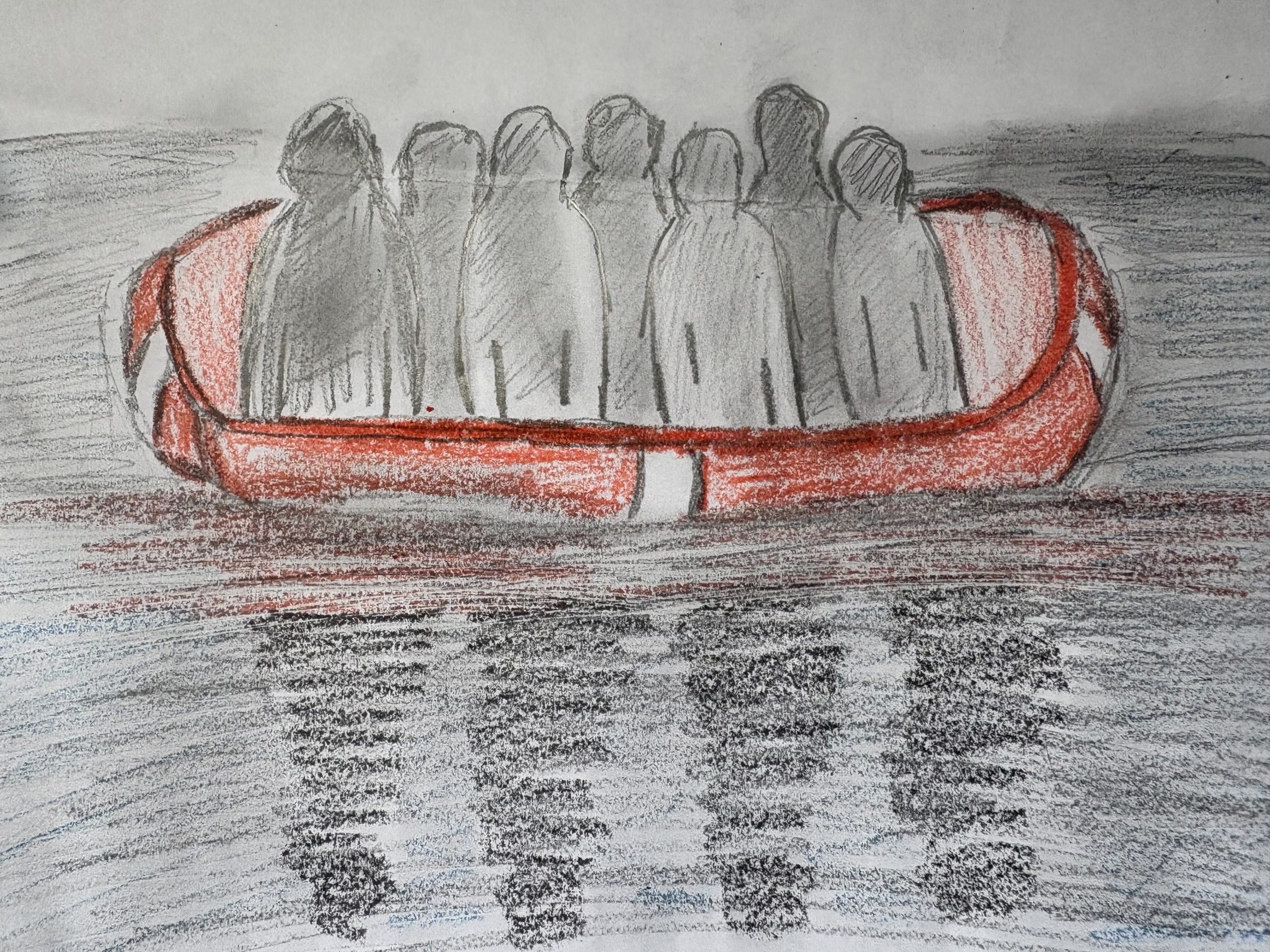
Ten hours.
Sure ten hours is not much when it comes to a lifetime. But when yer waiting and waiting, it can be cruel. It’s been ten hours since the last radio signal came in. Everyone on the island knew what it was like to wait for fishermen to dock. Everyone in the community had to keep going, working their jobs, dressing their youngsters, changing over the laundry. People kept giving me looks, as I pulled the garbage bins up the driveway.
“Ten hours Shirley hey, Roger knows how to handle ten hours”
“Their radio probably broke and they are still hard at her hey”
“Want me to come in and set you a cuppa tea?”
The clock ticked slowly. I picked up my phone every now and again to check the news, people’s prayers all over facebook. Roger’s face next to his shipmates.
Though the searchers had been called out, the fog had rolled in and it was impossible for them to see in front of themselves. How would Roger manage to see around himself? My mind crossed into the awful thoughts that two of the boys didn’t know how to swim.
Fishermen since the beginning of Newfoundland haven’t learned how to swim. It seems wrong but it keeps happening. They just jump on that boat and think a life jacket will save them from a storm. They comes back from their voyage and says they will learn how to swim for the next trip. They never do.
I tries my hand at something to make the clock move faster, but my focus doesn’t stay on one thing. One mug washed and not put away, two shirts folded and put back in the basket, television turned on and ignored. I go back to listening to the radio. The same thing over and over.
Seven men lost, families waiting, fog rolling in, searchers are looking all hours.
An announcer said “All Newfoundlanders know this story.” I am sure he meant we had all sent fishermen out and waited for them to come home, but it landed in me like a stone, slowly moving down my belly with a weight. The end of the story is that those men never came home.
The sealing disaster lost 137 men, one time three generations lost in a single disaster off Cape Spear, the Ocean Ranger wasn’t filled with fishers but the crew was lost to sea, marking a historical moment that still echoes off the waves. Brothers’ arms
wrapped around one another as they sank to the bottom of the ocean. The end of the story is rarely a miracle and if some husbands come home, not all of them do.
Fishing is how we came to be. We stole the land in exchange for the very existence of the Beothuks. Taking over their hunting coasts for our greedy bellies. They say John Cabot’s boat couldn’t dock because there were too many fish stopping him from coming to shore. Rolls and rolls of cod outlined the coast until the government ate it all up. Fishermen dealing with the feds to get its waters back, just like the Beothuk asking for their land, but not nearly as horrid. And yet here we are, haven’t figured out how to prevent death, prevent loss, even after all these years. Women at home wringing out dish clothes, meeting neighbours filled with tears at the altar to beg God for their husbands to come home, children wondering where the father is and why this trip is different.
The kettle was boiled, the floor was paced. The fog blanketed the waters and I thought of chances. What if those boys were right there, but they couldn’t see the land, searchers couldn’t see them. Would that make it more of a loss? If they were so close? Can that distance make the pain deeper?
A knock came to the door. Gerald Murphy stood on the porch and when he caught sight of me, he took his ball cap off, and held it in front of him. My body froze, he had news I didn’t have.
“Shirley, we are going to gather at the church to pray for a healthy return for your Roger and the boys.”
My body melted, my arms felt like rubber next to my body and I could feel energy return to me and zapped me in random places, the chest, balls of my feet. I came to and looked at Gerald Murphy.
“Alright then.”
“May I walk you down, it’s starting the once.”
I nodded and he came towards me slowly, unsure and hooked my arm into his, he stopped at the front door, unlocked me and fed my arms into the sleeves of a coat. He reconnected to me and we three legged slow-walked down the path to the church.
“Should I go back and get something Gerald? Some sandwiches?”
“No my love, don’t you mind yourself with any of that now. Someone else will handle that.”
We stood still on the path, my body half turned back to my home, as if Roger would be there waiting for me. I could see him in the kitchen cracking a beer, then I saw him blurry and bloated in the ocean. I felt his freezing legs dangling and the mounds of men by his side. Then I saw him in a dingy, surrounded by men, holding themselves together for heat, trying to find a joke of it all amongst the dark and fog.
Twenty hours.
Everyone else was in their homes in bed and I sat in front of the TV in the dark. A cold cup of tea next to me, a plate of sandwiches from the church wrapped tightly in Suran wrap. The church was full of hopeful conversation, prayers and pitiful eyes. Other wives of other fishermen gave me nods with wet eyes. Glasses of warm juice passed around, the news on an old box tv set with the volume on mute. Lots of people were getting information from Facebook, but it wasn’t guaranteed. My insides were flamed with anger, I didn’t want to hear anything that wasn’t real. All I could see was Roger in the dingy, his body cold, his heart slow and scared.
I knew I shared Roger with the town, but I only shared him as a fisherman. As a husband he was mine. His salt and pepper hair, his big hand settled on the small of my back, his short chuckle when I made a joke, how he kissed my forehead when he passed me coffee, with all sincerity, never rushed, always felt.
Gerald Murphy had walked me back from the church, but I couldn’t remember much of it. He asked if I needed him to stay on the couch or he could send his wife Mary down. He had two hands on my shoulders. I guess I had said I was fine on my own. I wasn’t but I couldn’t be with people. People who weren’t thinking about blue faces and frosted breaths.
I thought about Roger. How he left his tea bag in the cup, how he woke up every morning and pulled the blanket up over my shoulders and then smoothed it down. He laughed when the children woke up, even in the middle of the night, he walked into them with his arms out and let out a laugh. He loved when the dogs came out of the forest with a giant stick. He would say “well what have we here now?”
I figured people would reflect on their lives in big moments, weddings and child birth and death, but Roger came back to me in his habits. How he cupped my head when he hugged me in, how he grinded the coffee in the basement, not to wake anyone in the early hours. How he tossed out coffee grounds out in the back yard. How he took the pups outside every morning, with his coffee going cold in his hands, head up to the sky. He laughed so hard at Carol Burnett and Golden Girls. He saw women as these smarter, more hilarious beings. Every time I knitted a pair of mittens, which he saw a thousand of, he would say “Now would you look at that, some talented.”
I knew he was holding his own on the waters, if he was breathing, and he’d be holding everyone else’s too. He was a smart man, he knew what had to be done and knew his crew. Those waters are a beast and it doesn’t matter who is up against it, it will hold you under or freeze you to death. The ocean fights back for all we have taken, for all the garbage we had thrown into its depths over the years. The arms of God wrapping up fathers for sacrifice.
Thirty hours.
Roger had worn his new fleece the morning he went out. I cracked a grin at him now. He would invest in these good fishing clothes and then hesitate wearing them in case they got dirty. Eventually he would cave, knowing full well his new gear would get dowsed in fish guts and ocean salt immediately. I thought about how uncomfortable he was now and if he was thinking about the state of his clothing or maybe those concerns fall into the ocean when you’re surviving.
I hadn’t eaten much since the fog rolled in. I figured if there was a chance Roger was going without something to eat, I could too. A solidarity to him and his crew. I also was scared to eat, rolling myself slowly into normal behaviour, continuing life as normal without Roger meant I was accepting his absence.
I heard a racket from the church. I looked out my window and saw Gerald Murphy’s figure running towards my house. I locked the door and held my hand on the door knob. My throat swelled up and started to close over.
No no no no no. If I didn’t answer the door, I could not receive any news. Is a man lost at sea if you don’t know about it? Without knowing the truth, I could picture Roger on his boat, doubled over in laughter with his men, grasping at fish nets and swearing at the weather.
Gerald was banging on my door in desperation. Loud slams, he called out my name. It was urgent and boisterous, his knocks seemed neither excited nor defeated. I peeked out the window to see that he hadn’t removed his hat.
With the door still closed, I yelled out to him.
“Gerald, for Christ sake, just tell me.”
“They found them, Shirley, they found them all. They got them. They are safe.”
Forty one and a half hours.
“Did you hear me Shirley? Shirley? Our boys are coming home. Roger’s coming home.”
My body leaned against the door and I slid down to the floor. I let the boards swallow me.
I breathed out big heavy bellows and whispered my thanks to God.
“I heard you, Gerald.”









Leave A Reply